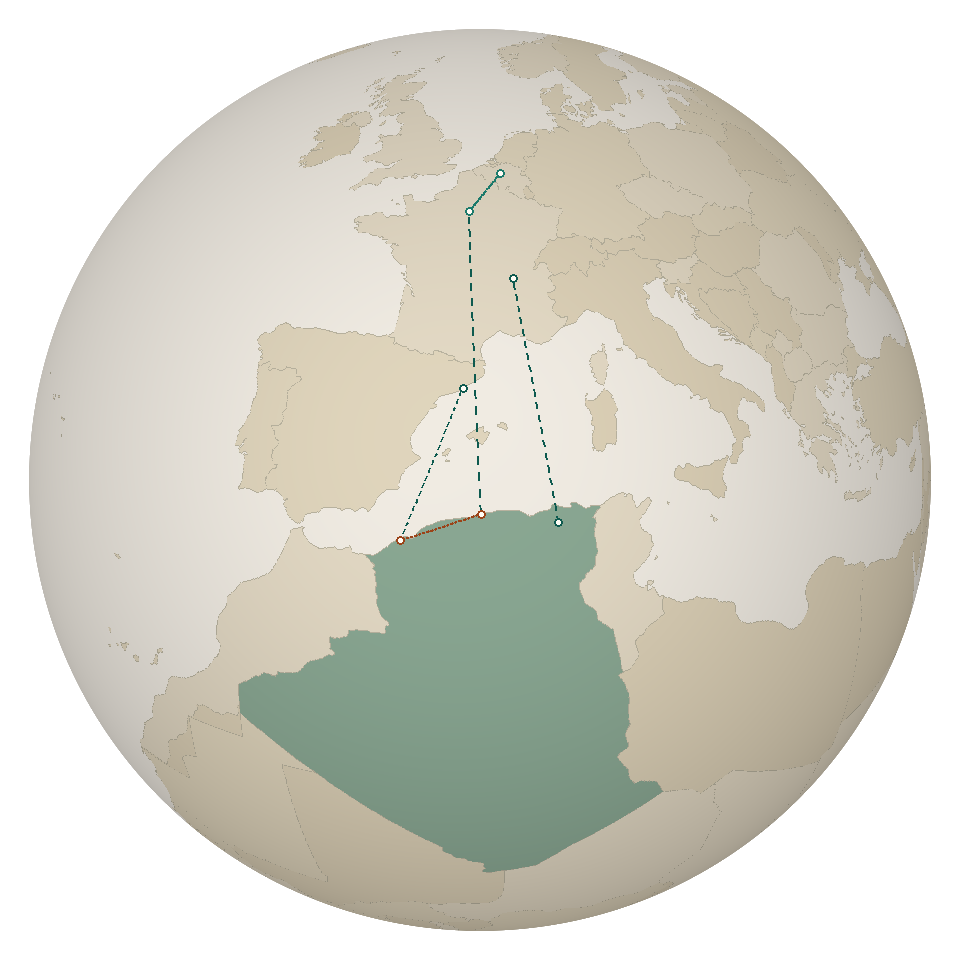
Flight legs
Air travel between the corridor’s airports. A flight leg is only matchable once the traveler’s transport proof has been approved.
Send parcels between Algeria and Europe with trusted travelers already making the journey — or earn by carrying on a trip you were taking anyway.
A trip already planned
AlgiersParis
Room for a package
The unit of the product
A traveler does not publish “Paris to Jijel”. They publish the legs they are actually taking, in order, with the space they actually have on each one. Matching then happens against a leg, which is why a parcel going only as far as Alger does not need a traveler who is continuing east.
Air travel between the corridor’s airports. A flight leg is only matchable once the traveler’s transport proof has been approved.
The road part of the same trip — Alger out to a wilaya like Jijel or Sétif. Drive legs need no vehicle document at launch.
Space is allocated on the segment a parcel actually travels. Two parcels can share one journey without competing for the same room.
Timing, capacity, weight, distance and detour are checked before an opportunity is shown at all. A paid boost improves visibility and adds a protected Traveler bonus, but it can never create a match that does not fit.
One account, two contexts
You do not choose a side when you sign up. The same account sends a parcel this month and carries one next month, and each context has its own short, ordered path.
Request → match → agree → pay → hand over → protection
Contents, weight and the cities at each end. Exact addresses come later, and only to a funded deal.
A small deposit puts the request in front of travelers. It is credited against what you pay, never charged twice.
Only journeys that actually fit the parcel, the dates and the route appear. Each one shows its legs and its verification state.
The sender proposes first. Both sides can ask questions and counter before anything is agreed.
Payment is taken when the deal is accepted and held pending delivery confirmation. Only now do the exact addresses unlock.
You give the traveler the pickup code at the door. That is what marks the parcel as collected.
Your recipient’s own code confirms delivery. A protection period runs before the traveler is paid, and you can open a dispute inside it.
Verify → journey → offers → carry → confirm → payout
Identity checks come before anything is publishable. A journey cannot be matched until they are approved.
Add each leg you are actually taking, in order, with the space you have on it.
Each flight leg needs approved transport proof. Drive legs do not require a vehicle document at launch.
Senders propose a reward to you. Accept, decline or counter — carrying is never automatic.
You may inspect the parcel before accepting it, and you should refuse anything unsafe or not as described.
The recipient reads you their own code at the door. You never hold it in advance and you cannot look it up.
Your reward becomes eligible once the protection period closes with no dispute open. Some payout methods settle manually.
The parts that protect both sides
Almost everything Wassla does that a chat group cannot comes down to four things: what stays private, when money moves, who can prove a handover happened, and how long you have to say something went wrong.
Before a deal is funded, both sides see cities and broad areas. The exact pickup and delivery details unlock to that deal and nobody else.
Publishing a request costs a small posting deposit. It keeps the marketplace made of real intent, and it is credited toward the total you pay — it is not a second fee.
Offers start from the sender and are negotiated in the open. Nothing is binding until both sides accept the terms and the payment is made.
The sender’s pickup code marks collection. The recipient’s delivery code marks arrival. They are for the physical handoff only and are never shared ahead of it.
The delivery code is not released the instant a parcel is collected. There is a short buffer after pickup before the sender can see it and the recipient is emailed their copy — and the traveler cannot obtain it at any point.
Delivery confirmation starts a protection period before the traveler’s reward is released. It exists so a problem noticed after the door closes still has somewhere to go.
Opening a dispute freezes the payout while evidence is reviewed. Both sides can submit what they have, and the outcome is recorded against the delivery.
With the protection period closed and no dispute open, the traveler’s reward becomes eligible for payout. Some methods settle manually and are shown as such.
Clear economics
Wassla’s fee is added on top of the reward you agree, not taken out of it. The traveler who agrees to €30.00 is owed €30.00.
EUR is the marketplace currency and every amount is calculated by the server. Where Chargily is offered, the DZD figure shown at checkout is a platform-configured conversion of the EUR amount — a payment-rail settlement, not a market exchange rate and not a second price. No payment provider is described here as live; each is announced when its activation is complete.
Example breakdownEUR
| Traveler receives | €30.00 |
|---|---|
| Wassla fee | + €7.50 |
| You pay | €37.50 |
A posting deposit already paid is credited against this total, not added to it.
Trust, stated plainly
These checks support the people using the marketplace. They do not replace your own judgment, they are not an insurance policy, and they are not a guarantee that a delivery will go well.
A traveler completes identity checks before any journey of theirs can be matched.
Every flight leg needs approved transport proof. A leg without it is not matchable.
Coarse locations before funding, exact details only inside the funded deal.
Two separate codes, used at the two physical moments. Never share one in advance.
Time between delivery confirmation and payout, so a problem still has a route.
A dispute freezes the payout. Evidence is reviewed and the outcome is recorded.
Before the first trip
Only legal, accurately described items that comply with the prohibited-items policy and the customs rules of the countries involved. The sender stays responsible for the declaration and for what is in the parcel.
A traveler must complete identity verification before publishing a journey that can be matched, and each flight leg additionally needs approved transport proof. Drive legs do not require a vehicle document at launch.
Delivery confirmation starts a protection period. The reward becomes eligible for payout once that period closes with no dispute open. An open dispute freezes it until the case is resolved, and some payout methods settle manually.
The outcome depends on the stage the deal had reached and on the cancellation policy shown when it was accepted. Any refund due is processed against the original payment and appears in your payment history. After pickup, a dispute is the normal path.
Because the code is the recipient’s proof that the parcel arrived. If the person carrying it could read it, it would prove nothing. It is issued to the recipient, and there is no screen, request or record that discloses it to the traveler.
This site describes the Europe ↔ Algeria launch scope. The mobile apps and the payment providers are announced as each one is activated; nothing here should be read as a claim that a provider is live today.
Get in touch
Questions about the corridor, a partnership, or the launch itself — write to the team. No parcel details are needed to say hello.